
The article addresses the specific but important issue of BDO and the SENT system. We explain which waste codes require additional transport notification and which Strict obligations are incumbent on the consignor, the carrier and the consignee. Discover how to avoid penalties for failure to notify shipments of hazardous waste.
Risks and penalties: Why does every trader need to know the SENT waste rules?
The System for Electronic Surveillance of Transport (SENT) is no longer solely the domain of fuel hauliers. From February 2022, it has become a key tool for monitoring the transport of waste SENT, aimed at sealing the market and reducing grey market traffic, especially in the context of hazardous substances. While BDO (Waste Database) is the basis for record-keeping, SENT adds a layer of control over the transport process itself.
Ignoring the obligation SENT waste declarationsy can lead to serious financial consequences. Fines range up to tens of thousands of zlotys, making knowledge of the precise SENT rules an absolute necessity. As a responsible company, you need to know: Do waste shipments need to be reported to SENT? The answer depends on the type of waste and the direction of transport.
Definition of obligation: When is a waste shipment notification required?
The obligation to use SENT is closely linked to the type and direction of waste shipments. In order to determine precisely, which waste in SENT must be reported, two main categories of transport must be considered:
1. Carriage of Hazardous Waste in Transboundary Traffic
In the case of import, export and transit through the territory of Poland, the monitoring obligation applies to almost all waste, and in particular to all hazardous waste.
The only exceptions to this are those wastes from the so-called 'waste'. green list (non-hazardous) which does not exceed 20 kg in weight. Any other consignment of waste entering, leaving or transiting Poland requires notifications sent waste.
2 SENT in Domestic Transport: Codes and Quantitative Thresholds
For shipments taking place entirely within the country, the regulations focus on specific high-risk waste codes.
Key wastes covered by SENT in domestic transport (including group 08 and other hazardous):
- Waste paints, varnishes, solvents and adhesives.
- Sludges and chemical deposits.
- Other precisely defined waste of a chemical nature.
ATTENTION TO THRESHOLDS: The obligation to declare national transport for these selected codes is activated when the gross weight of the consignment reaches or exceeds 1000 kg or its volume reaches or exceeds 1000 litres. Below these thresholds, no SENT declaration is required (BDO obligation remains).
Ensure legal compliance of waste shipments with our comprehensive environmental consultancy. Our experts will help you with the precise determination of whether a transport is subject to SENT.
The role of the actors: Responsibilities of shipper, carrier and receiver
in SENT
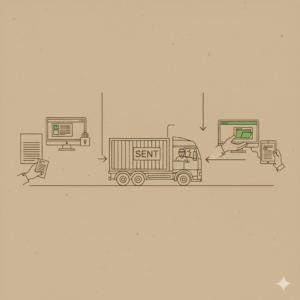
The effective operation of SENT is based on a tripartite responsibility. Each entity must fulfil its obligations on the Platform for Electronic Revenue and Customs Services (PUESC).
A. Obligations of the Sending Party (Waste Shipper)
The onus is on the sender to initiate the process. Before starting transport of hazardous waste he must make a declaration in the system. A key step is to generate and transmit to the carrier a unique SENT reference number, without which transport cannot begin.
B. Obligations of the Carrier (Executor of the transport)
The haulier is obliged to complete the notification with data concerning the means of transport (registration number, planned time of transport) and, most importantly, to ensure continuous monitoring of the route. This requires the transmission of geolocation data of the vehicle (via the ZSL locator or the e-TOLL PL application). The driver must be in possession of the SENT reference number and be ready to present it during the inspection.
C. Obligations of the Receiving Party (Final Recipient)
The SENT process does not end with the delivery of the goods. The receiving entity is obliged to close notification in the system, confirming receipt of the goods. This should be done no later than the next working day upon delivery of the consignment. This is the final proof of the legal completion of the monitored shipment.
Applications for your company
Proper waste management requires a synergy of actions: from BDO records (check: Company waste management: https://ekopro-grupa.pl/baza-wiedzy/postempowanie-z-odpadami-w-firmie/) through to precise SENT declarations for transport. Companies that neglect BDO simplified waste register (more here: https://ekopro-grupa.pl/baza-wiedzy/uproszczona-ewidencja-odpadow-bdo/) and, at the same time, incorrectly fulfil their SENT obligations, are particularly vulnerable to checks and severe sanctions.