
What is the KOBiZE report and why should it not be ignored?
The deadline for submitting the annual report to the National Balancing and Emissions Management Centre (KOBiZE) is the end of February. For many businesses, this is one of the more stressful obligations. The KOBiZE system, although it has a laudable purpose (monitoring air emissions), is not the most intuitive. In this article, we will guide you through the process and show you, how to fill in the KOBiZE report avoiding costly mistakes. It is a detailed KOBiZE manual, which will dispel your doubts.
Before you start: What data are needed for the KOBiZE report?
Before you even log on to the system, solid preparation is key.
Correct KOBiZE report is based on hard data for the previous calendar year.
To answer the question, what data are needed for the KOBiZE report, prepare first of all:
- Data on fuel combustion in installations: Annual consumption of gas, fuel oil, coal or biomass
by your heating boilers. It is best to collect invoices from suppliers. - Vehicle fleet data: Total annual fuel consumption (petrol, diesel, LPG) by all company vehicles (cars, vans, trucks) and working machinery (e.g. forklifts).
- Process data: If you run a paint shop, carpentry shop, welding shop -
you will need data on the amount of solvents, paints or welding wire used. - Technical data: Power of the installation (e.g. boiler in kW or MW), operating time of the installation per year.
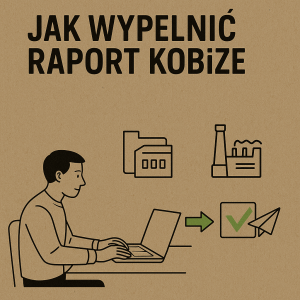
How to fill in the KOBiZE report - step by step instructions
We assume that you already have an account and an establishment in the KOBiZE system. If not, this is the first step. You can read more about who exactly needs to register in our KOBiZE Report 2026: A complete guide - who, how and by when must submit it?.
Step 1: Login and report selection Log in at www.krajowabaza.kobize.pl. Go to the „Reporting” module and select „Enter report”.
Select the reporting year (i.e. the past calendar year).
Step 2: Organised emissions - combustion in installations (e.g. boiler)
This is the most common source of emissions.
- Select your establishment and then „Installations”.
- Find the „Fuel combustion” section and select the relevant item (e.g. „Boilers”).
- The key here is to specify the type of fuel (e.g. high-methane natural gas) and its total annual consumption.
- Important: Pay attention to the units! By default, the KOBiZE system requires data in Megagrams (Mg), i.e. tonnes, or thousand cubic metres. The system will convert the consumption into emissions of the individual gases itself.
Step 3: Fugitive emissions - processes and vehicles Many businesses forget this step!
- Vehicle fleet: This is the most common type of fugitive emission. In the report, you must give the total fuel consumption (petrol, ON, LPG) of all vehicles and mobile machinery assigned to the plant.
Here you do not report each car individually, but the total consumption of a given fuel type. - Other processes: If you have, for example, welding, you report on wire consumption. If you are painting - paint consumption
and solvents.
Step 4: Verify and send the KOBiZE report Once all the data has been entered, the system allows you to „Verify the report”. It will detect basic errors
(e.g. missing fields). If everything is correct, you can approve and send the report. Remember to do this before the end of February!
KOBiZE report - an example To better illustrate this, here is a simple KOBiZE report example:
- The company: Small office and warehouse.
- Sources of emissions:
- Gas boiler for heating (organised emissions).
- 3 petrol cars and 1 LPG forklift (fugitive emissions).
- Completing the report:
-
- In the section „Installations” -> „Fuel consumption” the company enters the annual gas consumption from the invoices (e.g. 5000 m³,
which the system will convert into thousands of cubic metres). - In the section „Fugitive emissions” -> „Engine fuel combustion” the company adds up the petrol consumption
from all 3 cars (e.g. 4,000 litres) and LPG from the truck (e.g. 1,000 litres) and enters these values, converting them into tonnes (Mg).
- In the section „Installations” -> „Fuel consumption” the company enters the annual gas consumption from the invoices (e.g. 5000 m³,

The most common mistakes of the KOBiZE, or how to avoid problems
How to avoid errors in the KOBiZE report? Pay attention to these traps - it The most common errors of the KOBiZE:
- Incorrect units (MOST ERROR!): The KOBiZE system loves Megagrams (Mg), or tonnes.
Entering data in kilograms, litres (instead of m³) or kilowatt-hours (MWh) instead of Gigajoules (GJ) is an easy way to over- or underestimate emissions by a thousandfold. - Forgetting the fleet: Many think that KOBiZE is only about chimneys and boilers. Wrong. Emissions from transport (company cars, forklifts) must be reported.
- Omission of „minor” sources: Do you use a generator? Do you have air conditioners
(F-gas emissions)? This may also need to be reported. - Failure to submit a zero report: If you have a registered installation but it has not been used in a given year (e.g. a back-up boiler), you must submit a zero report. No report is no report.
Control authorities (such as the WIOŚ) are increasingly verifying data from the KOBiZE. Gross errors or missing reports can lead to unpleasantness, as can omissions of
in the Waste Database (check: BDO penalties).
Completing a KOBiZE report is complicated - have a specialist do it for you environmental counselling. Our team will go through the invoices, convert the units and assemble your KOBiZE report correctly
and on time.