
Construction and renovation waste under BDO regulations, a guide for construction companies
Construction and renovation waste is one of the most frequently generated wastes in economic activities. Demolition, modernisation of buildings, installation or finishing work generate large amounts of rubble, insulation materials, packaging from construction chemicals and other residues from construction work. According to the applicable regulations, entrepreneurs operating in the construction sector must correctly classify waste, keep records in the BDO system and hand it over only to entities that hold the relevant permits for its processing.
In practice, construction companies often encounter difficulties in determining who is responsible for the waste generated on the construction site - the investor or the contractor - and how to keep proper records of construction waste in BDO. Problems also arise in determining the correct waste codes for materials such as rubble, polystyrene foam or mortar and adhesive packaging. Incorrect waste classification or lack of record-keeping can result in administrative fines and problems during inspections by environmental authorities. Therefore, knowledge of the principles of construction waste management is essential for any company operating in the construction or renovation industry.
BDO construction waste - what obligations do construction companies have?
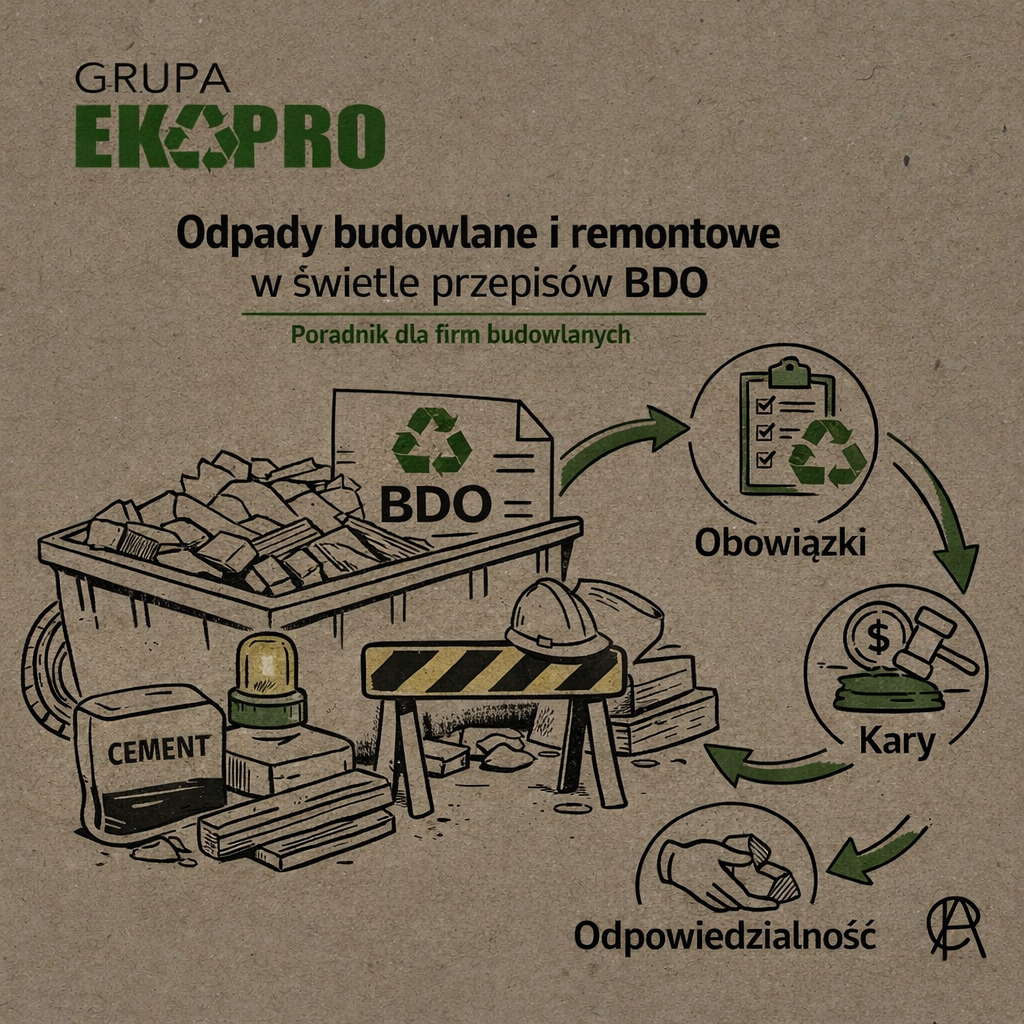
Businesses carrying out construction activities are treated as waste generators if their activities generate non-municipal waste. This means that a company carrying out renovation, demolition or installation work is required to keep records of construction waste in the BDO system.
The primary responsibilities of entrepreneurs include:
- registration with BDO as a waste producer,
- classification of waste according to the waste catalogue,
- keeping waste record sheets,
- issuing waste transfer notes (KPO) when waste is transferred for transport or management,
- the preparation of an annual report on waste generated.
Construction waste can include a wide variety of materials, such as concrete rubble, brick rubble, ceramic materials, insulation components, as well as paint, adhesive or mortar packaging. Each of these wastes must have a corresponding waste code and be included in the records kept by the company.
In practice, this means that the construction company should keep accurate records of the amount of waste generated during the project and document its transfer for further management.
Who is responsible for waste on site the developer or the contractor?
One of the most common problems in the construction industry is determining who is responsible for waste generated on a construction site. In practice, much depends on the provisions of the contract between the investor and the contractor, but the basic principle arising from the regulations is that the waste generator is the entity whose activity causes the waste.
In most cases, therefore, the responsibility for waste lies with the building or renovation contractor. It is his or her activities such as dismantling structural elements, removing finishing materials or preparing surfaces for new installations that create waste.
In practice, this means that the construction company should:
- keep records of waste in the BDO system,
- classify waste according to the waste catalogue,
- issue Waste Transfer Notes when handing over waste for transport,
- ensure their transfer to a duly authorised installation.
The developer can only assume responsibility for the waste if this is explicitly stated in the contract and if it has the appropriate entry in the BDO allowing it to manage the waste.
Construction waste records and waste codes in practice
Correct recording of construction waste requires proper assignment of waste codes according to the waste catalogue. In the construction industry, the most commonly used codes are those from group 17, covering waste from the construction, renovation and dismantling of buildings.
Among the most common are:
- 17 01 01 - concrete rubble
- 17 01 02 - brick rubble
- 17 01 07 - mixed concrete, bricks and ceramics wastes
- 17 06 04 - non-hazardous insulation materials
- 15 01 02 - plastic packaging
Choosing the right code is not only important for record-keeping, but also for how the waste is stored and further managed. Concrete rubble, for example, can be recycled and reused as construction aggregate, while waste containing hazardous substances requires specialised treatment.
Proper documentation of the waste transfer is also an important element of the system. To this end, the entrepreneur must issue a waste transfer card in the BDO system, which constitutes confirmation of the transport and takeover of the waste by the treatment facility.
Construction companies should also bear in mind the obligation to prepare annual reports on the waste generated. For details on this obligation, please see the article:
Report on waste generated
For larger projects, proper construction waste management often requires the support of environmental specialists. Professional environmental services for the construction industry make it possible to put documentation in order, avoid record-keeping errors and reduce the risk of administrative sanctions:
Comprehensive environmental consultancy for companies
FAQ, frequently asked questions
Does a renovation company need to be registered with BDO?
In most cases, yes. If a renovation company generates non-municipal waste, such as rubble, polystyrene, insulation materials or construction chemical packaging, it should have an entry in the BDO register and keep records of this waste.
Who is responsible for waste on site the developer or the contractor?
As a general rule, the responsibility lies with the construction contractor, as it is his activity that creates the waste. The builder can only take over these responsibilities if it is contractual and has the appropriate authority in the BDO.
What waste code does rubble have?
The most commonly used codes are 17 01 01 for concrete rubble and 17 01 02 for brick rubble. In the case of a mixture of different materials, code 17 01 07 is used.
Who issues the waste transfer note at the construction site?
The waste transfer card is issued by the entity transferring the waste, i.e. usually the construction contractor. The document is issued in the BDO system and confirms the transport and transfer of waste to the treatment facility.
Does the obligation apply to B2B sales?
In principle, the system applies to packaging going to the end consumer. In the B2B model, the situation requires individual analysis.
Does a small renovation company need to keep waste records?
Yes, if it generates waste in connection with a business activity. Exemptions from record-keeping only apply to small quantities of selected types of waste and in practice rarely cover the construction industry.
Can construction waste be disposed of in the municipal waste container?
No. Waste generated by business activities is not regarded as municipal waste and must be handed over to entities with the appropriate permits to manage it.
What is the penalty for not keeping records of construction waste?
Failure to keep waste records in BDO can result in high administrative fines, as well as consequences during inspections by environmental authorities.
Does the transport of construction waste always require documentation?
In most cases, yes. The transport of waste should be documented by a waste transfer note in the BDO system, which confirms the legal transfer of waste for further management.

 Polski
  English (UK)
  Deutsch
  Українська