What is a product charge and who has to pay it?
Product charge is one of the key environmental obligations for entrepreneurs placing packaged products on the Polish market. Who has to pay the product charge? In short, anyone who, as part of their business activity, places packaging or packaged products on the domestic market (is a so-called „introducer”). This obligation applies to manufacturers, importers as well as intra-Community acquirers.
This fee is not a penalty in itself, but a financial mechanism to motivate companies to achieve certain levels of recovery and recycling of packaging waste. If a company is unable to prove (through DPO/DPR documents) that its packaging has been recycled by the required weight, it must pay a financial equivalent - precisely in the form of a product fee.
How do I calculate the product charge? Step by step
Correct calculation of the product charge is crucial to avoid reporting errors and potential penalties. This process requires precise monitoring of the weight of packaging entering.
Model and necessary data
To calculate the product fee, we need three key pieces of information:
- Packaging weight: Total weight of packaging (in kg) placed on the market in a calendar year, broken down by type (e.g. paper, plastic, glass).
- Required recycling rate: Percentage recycling rate specified by regulation for a given year and type of packaging.
- Rate of charge: Rate (in PLN/kg) set by regulation, different for each type of packaging.
The fee shall be calculated only on the weight of packaging for which not We have achieved the required level of recycling.
Practical example of fee calculation
Let us assume that company „X” has launched 10,000 kg (10 tonnes) of plastic packaging in 2024.
- Mass introduced: 10 000 kg.
- Required recycling rate (example): Let's assume that for plastic it is 50%. This means that the company has to ensure that 5 000 kg (10 000 kg * 50%) is recycled.
- Level achieved: Company „X” has not taken any action (it has not cooperated with a recovery organisation or collected DPR documents). Its achieved recycling rate is 0 kg.
- Mass to be charged: 5 000 kg (required level) - 0 kg (achieved level) = 5 000 kg.
- Rate of charge (example): Let us assume that for plastic it is £2.70/kg.
- Product fee payable: 5 000 kg * £2.70/kg = £13 500.
Can the product charge be avoided?
Two main paths
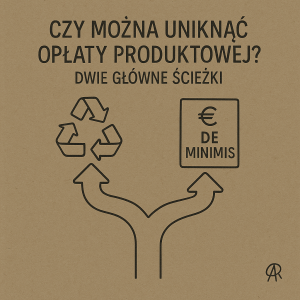
The question that many entrepreneurs ask themselves is: is it possible to legally avoid paying this fee? Yes, there are two main methods.
Route 1: De minimis aid for product levy
De minimis aid is a form of public support which, in the context of packaging, allows for total exemption from the product charge. It is a solution dedicated primarily to smaller entrepreneurs.
Path 2: Cooperation with a packaging recovery organisation
The second, and most common method chosen by medium and large companies, is to outsource the recycling obligation to a specialised entity. This is known as the 'waste management system'. packaging recovery organisation, which, in return for a contractual fee (usually much lower than the product fee), takes over the obligation of the entrepreneur to achieve the required recycling levels.
How do I benefit from de minimis aid for a product charge?
In order to benefit from the exemption under de minimis aid (packaging), the entrepreneur must fulfil several conditions together. Here they are step by step:
- Weight limit: The company must market a total of no more than 1,000 kg (1 tonne) of all packaging in a calendar year.
- Reporting at BDO: Fee exemption does not release from the obligation to register with the BDO or to submit an annual reports on products and packaging. These must be submitted to the system by 15 March.
- Making statements: Along with the annual report in the BDO, the entrepreneur must submit the relevant certificates or declarations of de minimis aid received (or not received in the relevant period).
Fulfilment of these conditions makes it legal not to pay the product fee for the year in question.
Product fee and obligations in BDO
It should be remembered that product fee is inextricably linked to the BDO system. It is on the basis of the data entered in the records (and subsequently in the report) that the charge due is calculated or the entitlement to de minimis aid is verified.
All of these activities - from record-keeping to reporting to fee calculations - are key obligations of traders in the BDO system. Failure to submit a report or miscalculations may result not only in having to pay the outstanding fee plus interest, but also in heavy administrative penalties.
To find out more about the reporting process itself, check out our post: Report on packaging introduced. de minimis aid, calculation of product fee, packaging recovery organisation.
Summary: Professional support in calculations
As you can see, calculating the product charge is a challenge, which requires excellent knowledge of regulations, rates and reporting obligations. Outsourcing an obligation to a recovery organisation or using a de minimis aid (packaging) are effective ways to optimise environmental costs. If you are lost in the maze of regulations, are unsure whether your calculations are correct, or want to ensure peace of mind on formal matters - the see how we can help you within comprehensive environmental advice. Our experts will analyse your situation and implement the most favourable solutions.